
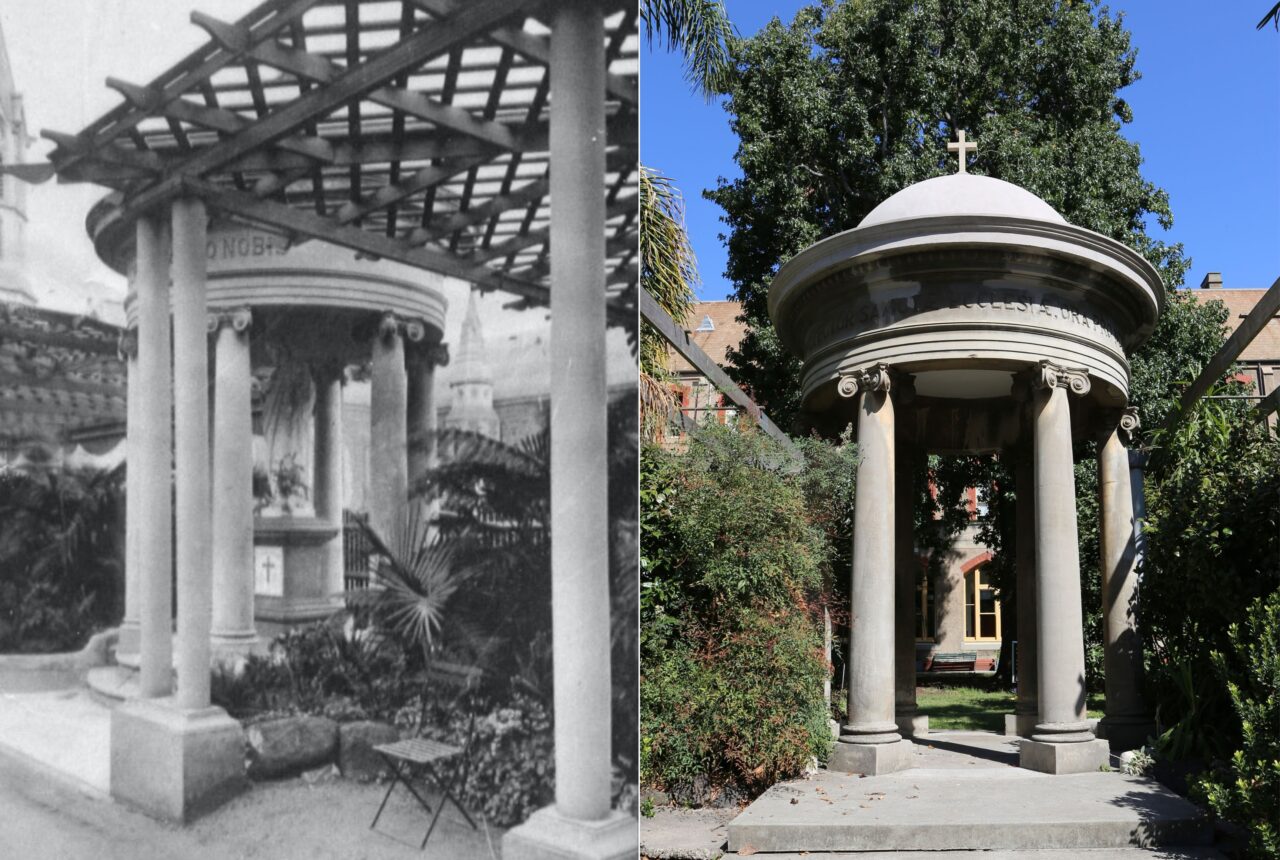
A century after the Tempietto was built in the heart of Abbotsford Convent, its tiny columns and classical details still tell a much bigger story.
Tucked into the courtyard of Abbotsford Convent the ‘little temple’ is small, elegant and almost theatrical. An engraving on the base of one of the columns marks its completion as the 29 September 1926.
For heritage architect Nigel Lewis, the little structure is a reminder of just how much history is contained within the Convent precinct.
“It’s the one building in the Convent that’s classically designed,” Lewis explains. With its tapered columns, ornate capitals, cornices and incised lettering, the Tempietto has the appearance of “something out of Rome”.
The word tempietto means a small temple. Its design echoes the circular temples of ancient Rome, later revived during the Renaissance, but reduced to an intimate scale for the Convent courtyard.
Its history, however, begins with something that was never built.
The iconic Convent courtyard was originally intended to be enclosed on all four sides, with a covered arcade completing a cloister where the Sisters of the Good Shepherd and their novices could walk in privacy. But funds ran out.
For two decades, the northern side remained comparatively rudimentary, until the 1920s, when the Tempietto was constructed, flanked by a garden and pergola.
At its centre once stood a statue of St Joseph. When the Sisters sold the site in 1975, the statue was removed and its plinth cemented over. Its whereabouts today are unknown.
What would life have been like at the Convent in 1926?
“By 1926, the Convent was effectively a village of around 1,000 people, including 300 religious women and hundreds of girls and young women,” says Lewis. “The gardens and farm were also flourishing.”
Today, the Tempietto has a new life. Depending on the moment you happen to walk past, it might be a hidey-spot for a child, a meeting point for friends, or somewhere to find a moment of respite.
Lewis knows the Convent intimately. In the late 1990s, he joined the community campaign against plans for a large housing development, helping establish the Abbotsford Convent Coalition. After seven years of campaigning, the site was transferred to the Abbotsford Convent Foundation, and Lewis continued his involvement as a conservation architect.
“The success of the project far exceeds the initial expectations of the Abbotsford Convent Coalition,” he has said. “What is most gratifying is how the Abbotsford Convent has now become such an accepted part of the life and culture of Melbourne.”
The Convent today is a community-own, not-for-profit precinct for arts, culture and learning.
CEO Justine Hyde describes the Convent as more than a beautiful heritage site, calling it “a representation of thousands of women and girls” and a place for artists, families, audiences and the wider community.
“It’s a real privilege to be the custodian of a place like the Abbotsford Convent. We’re looking after something that belongs to all of us, including the buildings, gardens, and the stories that bring this place to life.
The Tempietto is a beautiful example of that. Our role is not simply to preserve these things, but to care for them, share their stories and make sure they continue to have a life in the community for generations to come.”